Departments, administrators and memberships
Departments group people, extensions, queues and ring groups. This page covers three features that let you share the work of running a company: department administrators, extra memberships and music on hold per department.
Department administrators
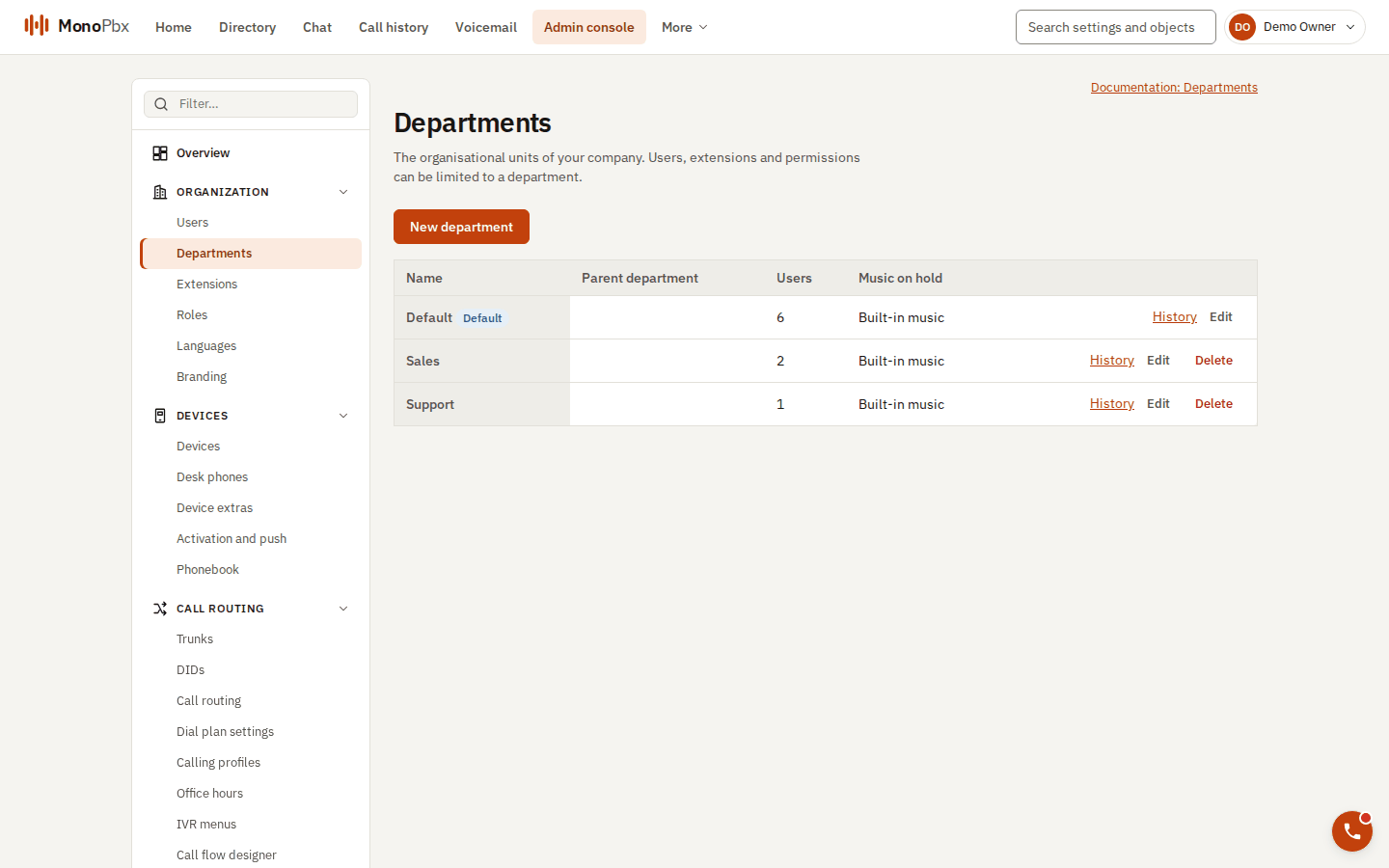
The Departments page.
A department administrator manages their own department and nothing else. You make someone a department administrator by giving them the built-in Department Admin role for one department.
A department administrator can:
- see and manage the users, extensions, devices, queues and ring groups of their department,
- move people into and out of their department, if they manage both departments,
- give and take away roles in their department, never more than they hold themselves,
- read the recordings and reports of their department.
A department administrator cannot:
- change the department itself, its roles, the company settings, trunks, dial plans, integrations, AI settings, API keys or the audit log,
- change the account of the Owner, a Manager, or a person who also supervises another department,
- see or change anything in another company.
If a department administrator asks for something outside their department, the answer is "not allowed" and nothing changes.
Extra memberships
Every user has one primary department. The primary department decides where the user's extension, devices and voicemail live.
A user can also belong to other departments. An extra membership lets the user take part in those departments' queues and see their calls on the switchboard, without moving their extension.
Each membership has its own role. A person can be a Supervisor in Sales and a plain User in Support at the same time.
Music on hold per department
A department can have its own music on hold, so callers waiting in that department's queues hear the department's music.
For the full list of roles and permissions, see Users, departments and roles.